The Dance of Reproaches: Why We Always Repeat the Same Argument
Author
Melyara Team
Date
Apr 24, 2026
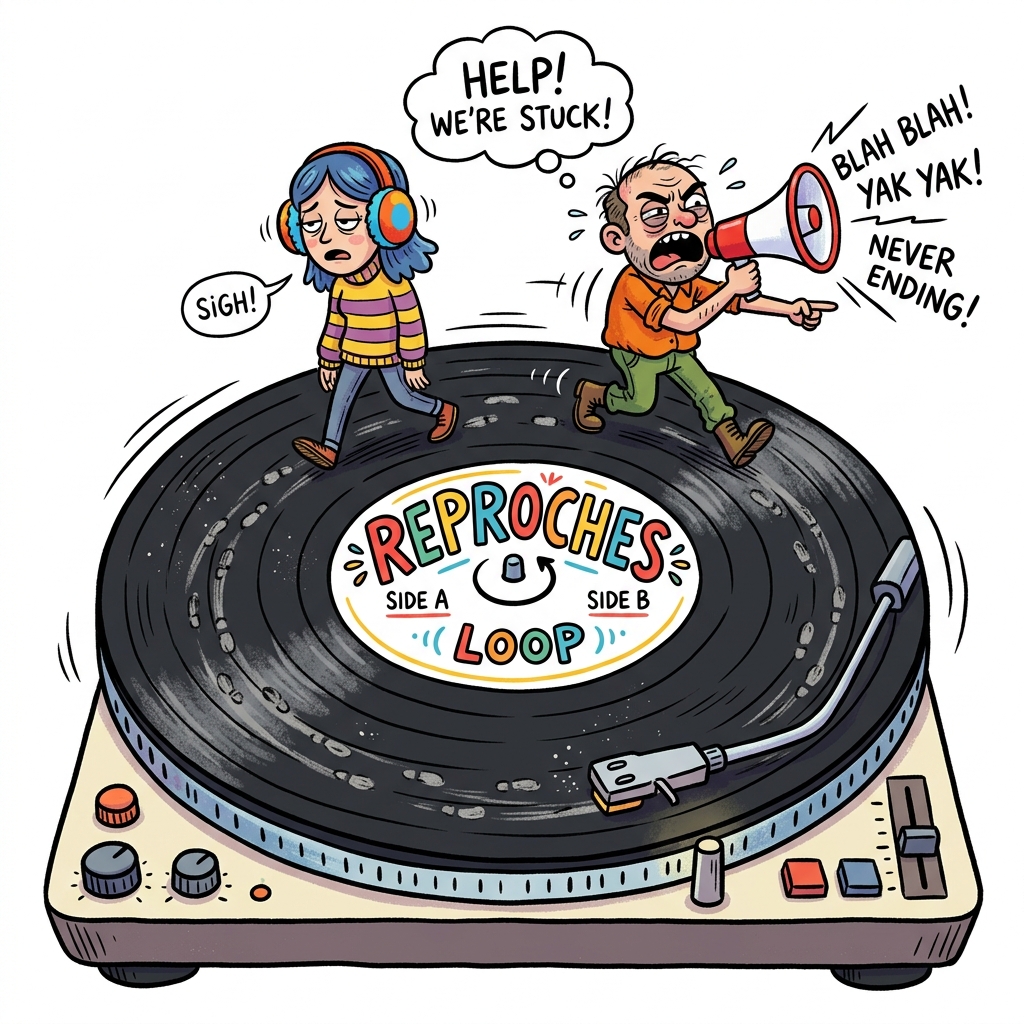
We all know that agonizing feeling. It starts with something seemingly insignificant —unwashed dishes, a slightly sharper tone of voice than usual, a delay of barely five minutes— and before we know it, we are submerged in the middle of the same argument we had last month, and the month before, and the month before that. In relationship therapy and relational mediation, these are called circular arguments or redundant interaction patterns, and they are, without a doubt, one of the primary causes of exhaustion, erosion, and hopelessness in a long-term relationship.
The Invisible Choreography of Our Fights
Imagine for a moment that every argument is not a battle of logic, but a dance—a perfectly rehearsed though deeply painful choreography. When your partner makes a move (a reproach, a look, a sigh), you respond with another predictable and automatic move (a defense, a counterattack, a silence). This sequence repeats so many times over the years that the nervous system automates it completely.
The real problem here is never the superficial topic of the discussion—be it money, family logistics, sex, or household chores—but the very structure of the interaction itself. As Dr. John Gottman pointed out after decades of observation in his "Love Lab," the secret of couples who endure is not the absence of conflict, but the ability to stop the escalation and make effective repair attempts before the damage is irreparable.
"A reproach is, in its deepest essence, a request for a need expressed in a tragic and counterproductive way."
The Neuroscience of the Infinite Loop
Modern neuroscience offers us a fascinating and at the same time terrifying explanation of why it is so difficult to break out of these loops. When we perceive what we interpret as an emotional threat (a reproach like "You never help me"), our amygdala—the brain's alert center—takes total control in milliseconds. In that instant, the blood supply to the prefrontal cortex, the part in charge of logic, empathy, and problem-solving, is drastically reduced.
We enter what is called "amygdala hijacking" or survival mode. Biologically, we only have three options: fight (defending ourselves by shouting or blaming), flight (leaving the room), or freeze (the silent treatment). This response generates an equivalent reaction in the other person, creating a symmetrical escalation where no one is really listening; both are simply waiting for their turn to launch the next arrow.
How to Identify if You Are in a Circular Argument
- You feel like you are speaking different languages and that the other doesn't understand your point of view.
- The argument scales from 0 to 100 in less than a minute over trivial issues.
- The "here we go again" feeling appears, as if you knew exactly what the other was going to say next.
- When finished, you feel exhausted and with the feeling that you haven't resolved anything.
- You start arguing about the dishes and end up bringing up topics from three years ago.
Roadmap to Break the Dance
To break this destructive dance, it is absolutely necessary for one of the two to have the presence of mind to stop following the habitual steps. This has nothing to do with "giving in," "losing the battle," or "agreeing with the other." It is about radically changing the playing field to save the bond. It is an act of emotional leadership.
If instead of responding to the superficial accusation ("You are a mess") you are able to respond to the vulnerable emotion pulsating beneath ("I feel overwhelmed and I need to feel that we are a team in this"), the dance changes direction completely. The other no longer has an attack to respond to, but a vulnerability that, if the relationship is healthy, they will want to protect.
Breaking the loop requires the heroic courage to be the first to lower your weapons and show yourself vulnerable to the other.
Melyara: Your Ally in Changing the Choreography
At Melyara, we have designed our tool precisely to force that necessary pause that the biological brain cannot generate on its own in the heat of the fight. By forcing you to write what you feel privately before any message reaches the other, we are hacking your nervous system to return control to your rational part.
Our artificial intelligence doesn't just clean the text of attacks; it helps you unearth the real need that your pain is trying to communicate. In the end, Melyara's goal is for you to go from being two opposing opponents to being a united team looking at a common problem. The dance of reproaches only stops when you learn to look not at the pointing finger, but at the wound that needs to be healed.